

We examine the benefits of whole body cryotherapy, exposure to extreme cold for therapeutic effect.
At some point in our lives, most of us will have experienced cryotherapy – healing through the medical use of extremely low temperatures. It might have been at a doctor’s surgery when we got a wart frozen off, or at home when we pressed a packet of frozen peas to a knock or a bump.
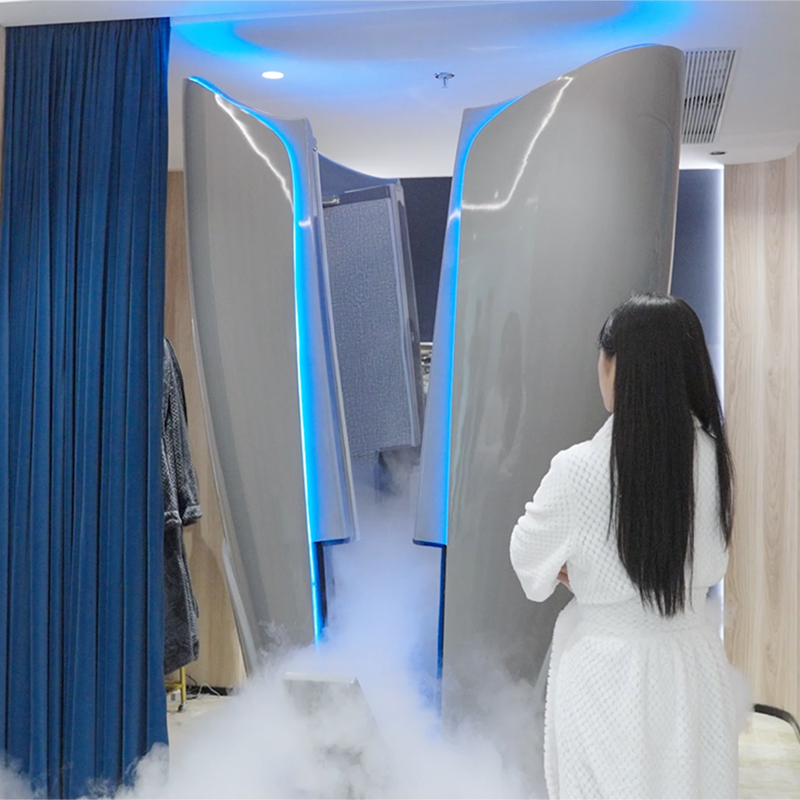
In recent decades, that principle has evolved into a health therapy, which is now extremely popular among elites sports men and women: whole body cryotherapy (WBC). This involves standing for two to three minutes in a sauna-style chamber filled with extremely cold dry air at temperatures of up to minus 150 degrees Celsius (equivalent to minus 300 degrees Fahrenheit).
Indeed, for English premier league football players it has become so much a part of their lives that club bosses became concerned about a rebound in injuries when they were temporarily banned from using it when the Covid-19 pandemic first struck.
So what are the purported health benefits and what does the latest research say?
1. Speeds recovery

One notable 2015 German study reported that endurance athletes improved their performance when they underwent cryotherapy between two running session spaced one hour apart.
This has been attributed to re-circulation theory. When our bodies are exposed to the cold, blood vessels narrow (vasoconstriction), re-directing blood away from the periphery towards the core in order to protect key organs.
As part of this process, blood is enriched with nutrients and oxygen, which then flows back to tissues once blood vessels widen again (vasodilation). The overall effect is to re-energise the recipient.
Vasoconstriction also helps to minimise injuries because less blood flowing through capillaries has a similar effect on fluid leaking from damaged vessels around the injury site. Swelling and inflammation are reduced.
2. Boosts the immune system
Cold also stimulates the body’s sympathetic nervous system into action – our flight or fight response to stressful situations.
As we previously explained in our article on ice bathing, this physiological shock provides a form of training for the immune system. Regular exposure to small shocks strengthens it, thereby enabling it to cope far better when it is exposed to bigger and more dangerous threat.
3. Improves sleep
Once our bodies sense that a danger has passed, the parasympathetic nervous system is activated. This slows everything down, including our breathing, enabling us to relax and eventually to sleep.
Cryotherapy helps to ease this process along. In 2021, a study led by the China Institute of Sports Science in Beijing, found that it not only improved sleep quality among the 12 long-distance runners studied, but had a greater effect than cold water immersion.
4. Reduces chronic pain
We all know that cold can dull pain. This is because it slows down electrical impulses passing through our nervous system.
In the late 1970’s a Japanese doctor called Toshiro Yamauchi used this theory to pioneer whole body cryotherapy to reduce pain and swelling in patients with the inflammatory joint disease, rheumatoid arthritis. Since then, it has become especially popular in Scandinavian and Northern European countries to treat a long list of ailments causing chronic pain.
In 2019, a Polish study highlighted that it could be more effective than conventional physiotherapy in treating inflammatory diseases of the joints like rheumatoid arthritis. Examination of 83 patients noted a decrease in their intensity of morning stiffness and pain, plus a reduction of the inflammatory marker c-reactive protein, which is produced in the liver.
5. Increases flexibility
A number of studies including one published in 2021 by the Journal of Clinical and Diagnostic Research, highlight that cryotherapy improves flexibility. A study of 40 recreational sports players showed a significant increase in calf and hamstring flexibility.
This is because while vasoconstriction reduces blood flow to the surface of large muscle groups, vasodilation increases blood flow at a deeper level. This, in combination with slower nerve conduction velocity, allows the muscle to relax and be stretched more fully.
 EN
EN  ZH
ZH